

snoopyversary
your guide to the mascots, trinkets, and silly little guys of 2025

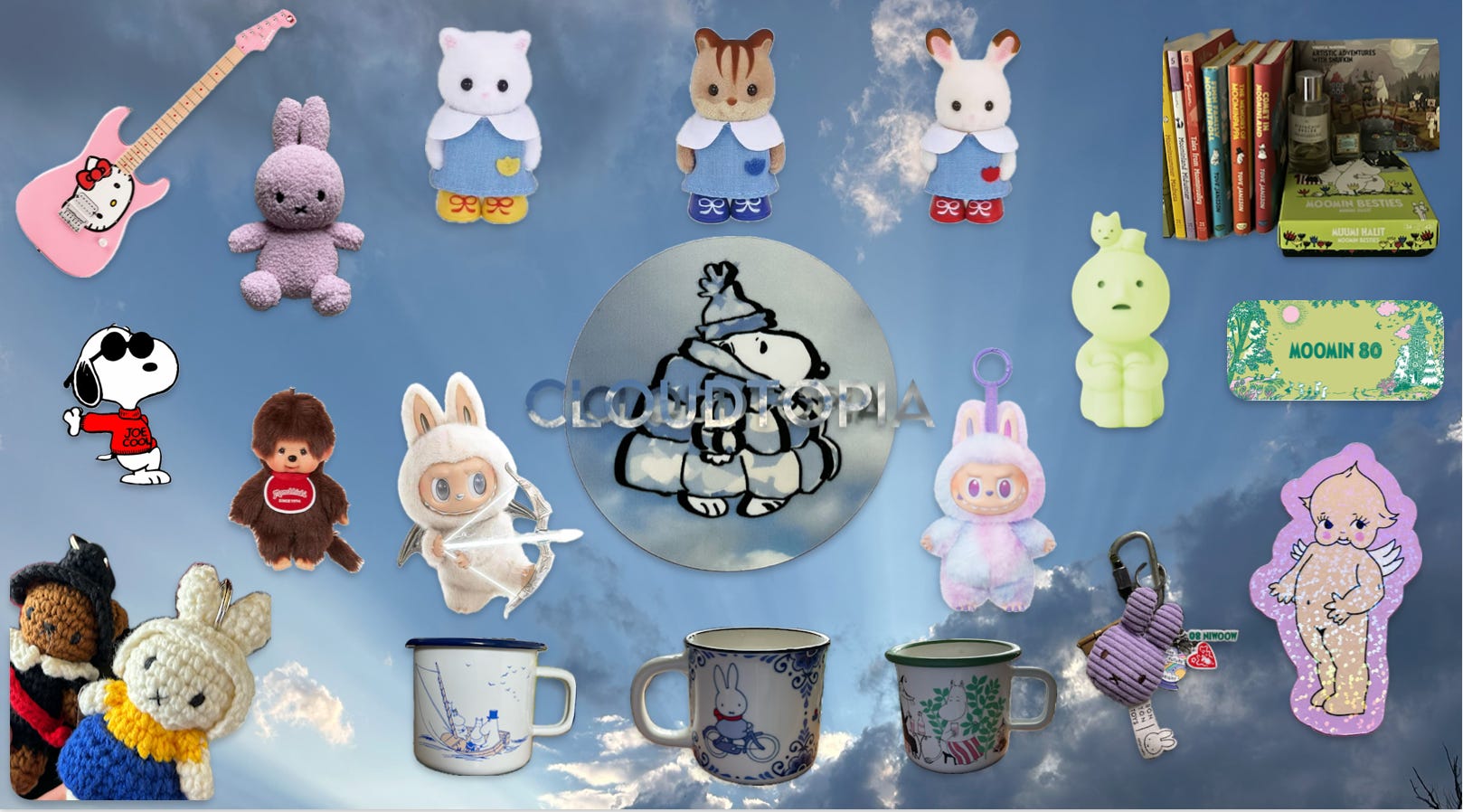
(note: cloudtopia is best viewed in a browser. if you received this newsletter as an email, you may need to open it elsewhere to read to the end ! )
Earlier this month, while visiting my home town, I was greeted on a saturday afternoon by an unprecedented sight: a bright pink, Hello Kitty themed van, and a queue that stretched all the way down the street of fans waiting to visit it. This was the Hello Kitty Café, and its appearance represented a pop up shop selling limited edition merchandise and sweet treats(a lot of which was already sold out by the early afternoon) to celebrate the café’s 10th anniversary.
This simple phenomenon kind of stunned me. I had never heard of the Hello Kitty Café, much less realised it was a full decade old. I had never seen Sanrio fans in my town, but here they were, dressed up in character themed outfits and carrying bags loaded with Hello Kitty merch and bag charms of characters from the Sanrio range(Pochacco, Cinnamoroll, and others) alongside other currently trending figures, like Labubus and Sonny Angels. I wasn’t even there for the event, but being a dedicated gen z representative I also had a Miffy keychain hanging off my bag, allowing me to blend right in with the crowd. This got me thinking about a few things: first, what is going on with cartoon characters and anniversary events this year? and second, how do we keep track of the current explosion of vintage cartoon characters and weird little guys that have become social media icons and the subject of keychains and bag charms and other little trinkets absolutely everywhere in the last few years?
In this newsletter, I’ve put together a brief guide on the strongest players in the game currently, the mascot characters celebrating big birthdays in 2025, and a few of the intersecting stories we can trace through these trending trinkets, from Snoopy to Hello Kitty to Labubu and the monsters.
(p.s. the cloudtopia august calendar page is also at the end of this letter!)
The Moomins
first appearance: 1945 children’s book The Moomins and the Great Flood
anniversary celebration: Moomin 80
creator: Tove Jansson
The Moomins are the creation of Finnish artist and writer Tove Jansson, who first wrote about the Moomin family in 1945. At the centre of these stories is Moomintroll(this character is sometimes referred to generically as just Moomin), a child who lives with his parents(Moominmamma and Moominpappa) and a cast of eccentric characters(Snufkin, Stinky, Little My, and many others,) in the idyllic Moominvalley. The Moomins have a simple silhouette, round, white bodies, long faces that many have compared to hippos, and faces characterised by their small eyes. This will be a bit of a pattern in this list - the people love roundish white creatures with small eyes! Their appearance is unique and strangely charming, and the design has taken off in popular culture, especially in recent years when we’ve seen a resurgence in interest in the characters. Jansson was a prolific artist and created a series of books and comic strips featuring these characters, along with other art; the Moomins have also appeared in animated shows and on a broad array of merchandise including mugs and tableware, charms and keychains, biscuits and sweets, etc. This year is the 80th anniversary of the Moomins, and it’s nice to see that not only the image of these characters has retained popularity, but so have their stories, their consciousness towards the environment and ecology, and the ethos of community, hospitality, and love that Jansson envisioned through her writing.
For more on the art career of Tove Jansson and Moominous trinkets:

Snoopy
first appearance: 1950 comic strip, Peanuts
anniversary celebration: 75th Anniversary
creator: Charles M. Schulz
Snoopy has become a global icon and has become arguably the most well known and beloved figure from Charles M. Schulz’ Peanuts comics. Originally from Minnesota, Schulz is regarded by many as one of the greatest cartoonists, and his work has been highly influential.1 The character of Snoopy was loosely based on Schulz’ childhood dog, and since his debut in a 1950 comic strip, he has appeared in numerous comics, all of the Peanuts cartoon specials, films, and tv shows.
 Tiktok failed to load.
Enable 3rd party cookies or use another browser
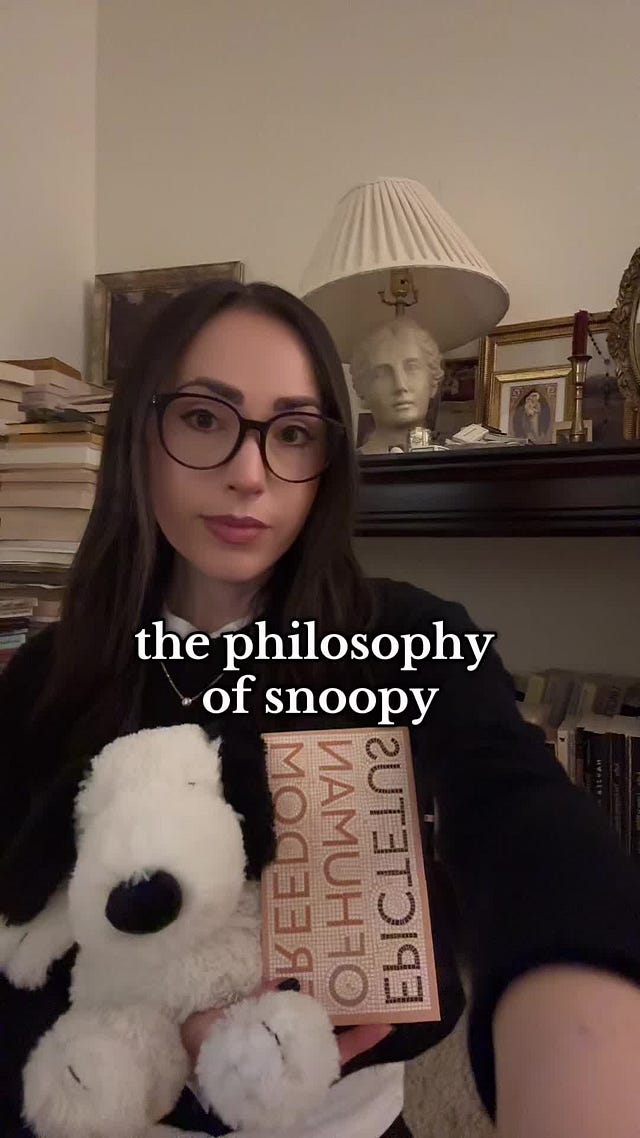
Snoopy is, to me, a perfect character, with a complex inner life and a love of silliness and mischief. And of course, he is a perfect dog, the best friend of Charlie Brown and a vital member of the Peanuts gang. His design makes him both easy to love and easy to merchandise. I’ve definitely noticed an uptick in his popularity in the last few years as he appears more and more on clothing or in keychain or plush form in stores, and edits of Snoopy have become big on social media. This year(officially his first appearance was in October, while his in-universe birthday is in August) marks his 75th anniversary, and I’m excited to see what celebrations for this incredible little guy come up in the next few months!
 Tiktok failed to load.
Enable 3rd party cookies or use another browser
Miffy(Nijntje)
first appearance: 1955 children’s book
anniversary celebration: Miffy’s 70th birthday
creator: Dick Bruna
Nijntje — known internationally as Miffy— is a cartoon rabbit designed by Dutch illustrator Dick Bruna. Bruna wrote many children’s books featuring Nijntje and friends, and she has also been the subject of cartoons and other artworks, tons of Miffy merch exists for children and adults alike, and across the Netherlands she appears frequently in public art and museum collaborations. Miffy’s image is iconic and easily recognisable and reproducible, consisting primarily of a rounded head, rabbit ears, dots for eyes and a mouth in the shape of an x. Bruna was inspired in his artwork by both American cartoons and 20th century Dutch design sensibilities, which shine through in the bold lines and minimalist designs of his characters.
I wrote a little about Nijntje, her 70th birthday celebrations, and Bruna earlier this year after visiting the Nijntje Museum in Utrecht, where Bruna lived and worked for most of his life:

Hello Kitty
first appearance: 1974 Sanrio merchandise
creator: Yuko Shimizu
Hello Kitty is perhaps the best known character from the world of Sanrio. Her first appearance in 1974 actually made her the second mascot in the line up after a 1973 character named Coro Chan, but since then she has cemented her legacy as a global star and an instantly recognisable character. Along with others like My Melody, Pompompurin, or Keroppi, Sanrio’s characters are cute, iconic, and perfectly designed for merchandising, and have appeared on countless items sold by the brand, in branded café’s, on limited edition guitars, in cartoons, and in the cozy game Hello Kitty Island Adventure, among other appearances.
Two Sanrio characters celebrating anniversaries in 2025 are My Melody(debuted 50 years ago) and Kuromi(20 years old), with a stop motion animated film about the two being released at the end of July.
Hello Kitty bears some resemblance to our previous entry, Miffy, which has caused friction between Sanrio and the Miffy/Nijntje company. Claiming that the design for Hello Kitty, with her extremely simple design, big white oval head, and minimalistic facial features, was copying his own design for Nijntje, Dick Bruna attempted to sue Sanrio for copyright infringement. Miffy remains a very popular character in Japan, where there are Miffy stores, cafés, and a Miffy hotel and other attractions at Huis Ten Bosch, a Dutch themed park in Nagasaki. (Our other previous entrants, the Moomins and Snoopy, are also popular figures in Japan, and Sanrio holds the Japanese licensing rights to Snoopy and other Peanuts characters.)
Another mascot/toy/cartoon character to appear on the scene in 1974 in Japan was Moncchichi, a baby monkey who has seen a recent resurgence in popularity among trinket enthusiasts and vintage toy collectors.
Sylvanian Families
first appearance: 1985 toys
anniversary celebration: Sylvanian Families 40th Anniversary
creator: Epoch
Also known as Calico Critters in North America, the Sylvanian Families are a range of small flocked plastic toys first released in 1985 that depict families of anthropomorphic animals dressed in retro-inspired clothing that live in Sylvania, a world that is part magical forest and part fantasy suburbia. Some sets contain complete families of 3-4 rabbits, cats, kangaroos, or other animals; others feature just the smaller ‘baby’ figures, or accessories, furniture, or houses for the Sylvanians.
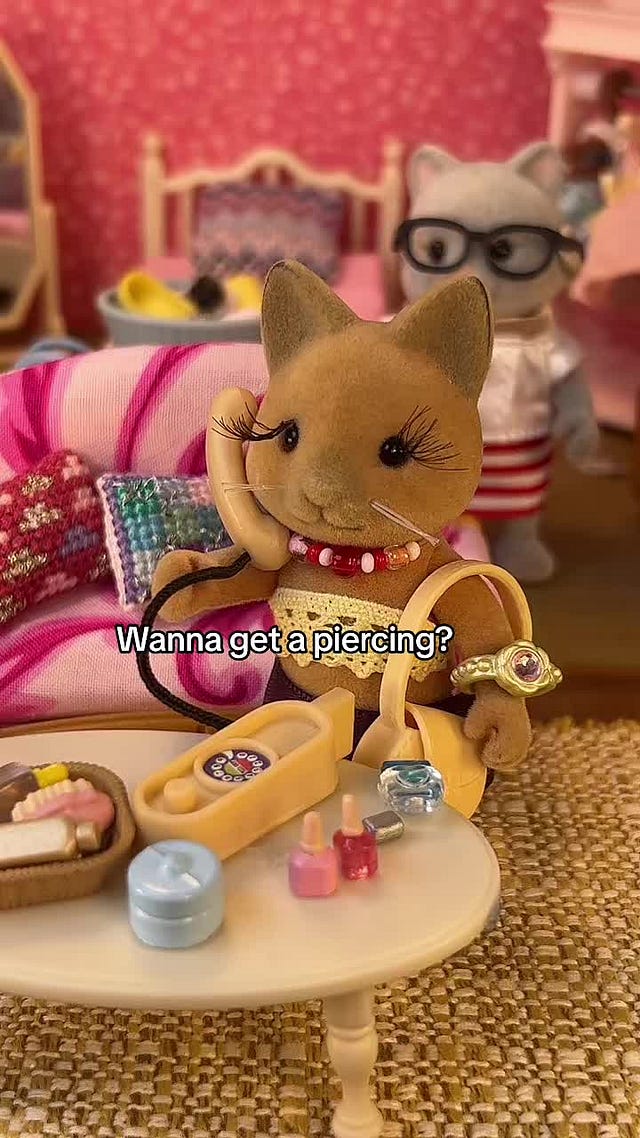
In the past few years, these toys have gotten incredibly popular online and are now a popular accessory or collectable for gen z and millenials. Fan accounts like Sylvanian Drama, which produces soap operatic tiktok videos with Sylvanian characters, have drawn a lot of attention to the figures(according to the company, not always for the better, as they are currently suing the creator of this account), and new products such as recent blind box series have also drawn more attention to these toys.
 Tiktok failed to load.
Enable 3rd party cookies or use another browser
I don’t generally like blind boxes. I don’t always like all the designs in a collection, and would much prefer to buy only items that I actually like. When I get a toy I don’t like as much I feel weirdly guilty. Overall, the element of luck and surprise that fuels blind box purchases does not appeal to me — but I have to confess to buying a few of these in the past, as the unique designs of the Sylvanian babies that are exclusive to blind box series with themed outfits are incredibly cute. The babies in particular make for great trinkets, as they are very small and easy to carry in a pocket or a bag, or have on display, making them a very popular pick for little guy collectors everywhere.
Sonny Angel
first appearance: 2004 toy
creator: Toru Soeya
Sonny Angel was launched in 2004 in Japan. The figures, the design of which was inspired by the 20th century American cartoon baby Kewpie(who I most associate with Kewpie Mayonnaise, another Japanese product to adopt this design), are sold in blind boxes, and each one depicts a babyish character with tiny angel wings and wearing nothing but a hat. I find the naked baby thing kind of creepy, but he has tons of fans.
The variety of designs and the blind box packaging encourages fans to collect the figures, and gives certain variations of the figure a sense of exclusivity. Sonny Angel became a viral online trend in 2023, and in the past few years the popularity of the character has skyrocketed, leading to online communities to form around the figures and collecting them, as well as increased recognition and media attention.
Smiski
first appearance: 2015 toy
anniversary celebration: 10th anniversary
creator: Toru Soeya
Another iconic blind box character from Toru Soeya, Smiski is basically just a little guy who hangs out, and I think glows in the dark? Like many on this list, Smiski is made iconic through a highly minimalistic design, and the very simple face of Smiski is inexpressive yet strangely compelling.
I could find only one reference on the official site to the fact that this year marks Smiski’s tenth anniversary, and it was in the news announcement for a special line of miniature charm figures being released this summer:
“Celebrating its 10th anniversary this year, SMISKI, the fairy who watches over you and loves corner, is now available as a mini-sized strap. From inside the surreal and adorable capsules shaped like SMISKI's faces, SMISKI with unique personalities emerge and quietly watch over you.”
What else needs to be said! Smiski watches over you and loves corner :)
Labubu
first appearance: 2015 storybook
anniversary celebration: 10th anniversary
creator: Kasing Lung
Last but certainly not least on our list for today is the incredibly popular and controversial Labubu! She's been called ugly, cute, creepy, satanic, a micro trend final boss, and much more. I had never heard of Labubu before this year, and I was surprised to learn that she has a longer history — although one that, in spite of her current celebrity status, still seems relatively unknown.
Creator Kasing Lung was born in Hong Kong and raised in Utrecht, Netherlands(the same town where Miffy creator Dick Bruna lived and worked) and is now based in Belgium and Hong Kong. Lung is an artist and illustrator whose quirky images and characters are inspired by his interest in European and particularly Nordic folklore, and his most popular character, Labubu was originally envisioned as an elf. The character first appeared in 2015 illustrations, and he wrote and illustrated three children’s books known as the Monster Trilogy featuring Labubu and friends. In spite of the absolutely overwhelming popularity of Labubu, I found it nearly impossible to find good sources about her origins, and have been completely unable to get access to these books. Since being licensed by Pop Mart for blind box figures and toys, Labubu has taken on a life of her own and become more of a mascot figure than a character with a narrative. The only images of the original books I’ve come across were posted by Kasing Lung to twitter earlier this year. The illustrations and storytelling have a dark, unsettling quality, and the appearance of monsters and elves in the stories demonstrates a more complex and folkloric quality to Lung’s designs that is largely forgotten in today’s Labubu craze. Even the titles — “Miró’s Requiem”, “The Story of Puca”— are unexpectedly literary. The most surprising thing of all, to me, about this source, is noticing that both of these tweets, which were posted by the creator of one of the internet’s most popular characters, have fewer than 100 likes. Labubu mania seems to be a phenomenon completely independent of context.
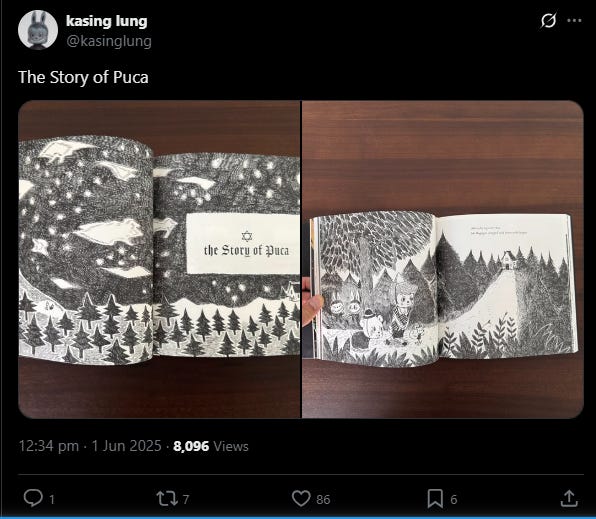
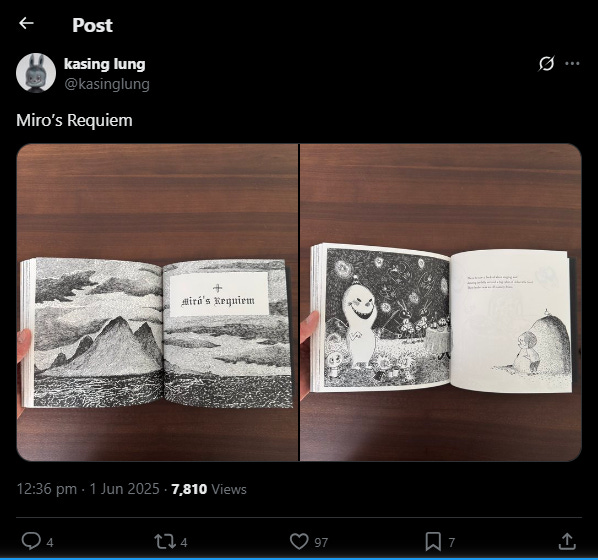
How, then, has Labubu risen to her newfound fame? The Popmart figures have been around since 2019, but many point to 2024 posts made by actor and kpop idol Lisa sharing her own Labubu as a turning point in the popularity of the character.
Today, there are well over a hundred Labubu variations, and new blind boxes regularly sell out. The character’s popularity and all of the drama surrounding it, including fights in stores over rare Labubu figures, soaring prices, and Lafufu(fake Labubu) controversies, have become a topic of discussion everywhere online and reached mainstream news sources. Labubu has drawn plenty of criticism and attention from haters — there are serious issues to be discussed about the way that blind boxes encourage overconsumption and can cause psychological effects similar to gambling, there are concerns about the social impacts of Labubu as a status symbol among younger generations, (somewhat warranted) mocking of internet obsessions and gen z terms through mash-up nonsense phrases(labubu matcha brainrot dubai chocolate),2 and on and on. But she also has gained a massive following of genuine fans. Even though I went into my Labubu research as a skeptic, I couldn’t help but be charmed by the community I found celebrating her online, where people share pictures of their Labubus dressed up in handmade outfits and celebrate the joy they get from Labubu as friend, fashion accessory, trinket, status symbol, lifestyle, and creator of community.3
thank you so much for reading! I have been pretty fascinated by the trends of trinkets and bag charms that have developed over the past few years in both online and irl spaces, and I had a lot of fun looking into the histories of some of the characters I regularly see in various forms and trying to better understand their origins, the creative and cultural space they take up today, and the long legacies of some of our favourite cute mascots and weird little guys.
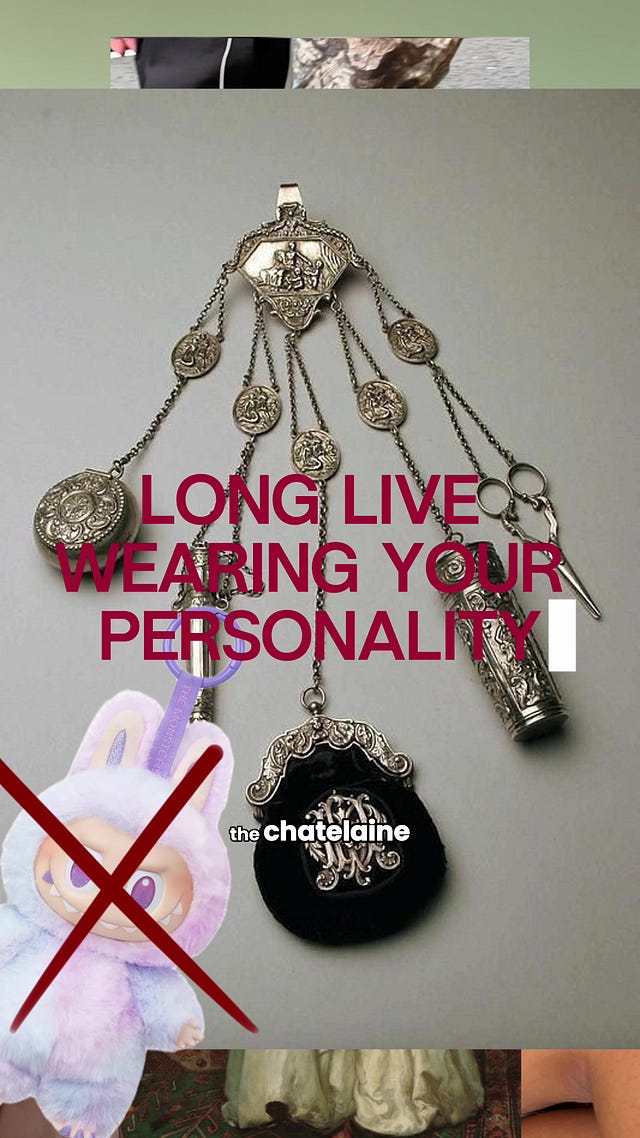
more to think about: “LONG LIVE WEARING YOUR PERSONALITY” — are bag charms the newest iteration of the châtelaine ?
 Tiktok failed to load.
Enable 3rd party cookies or use another browser
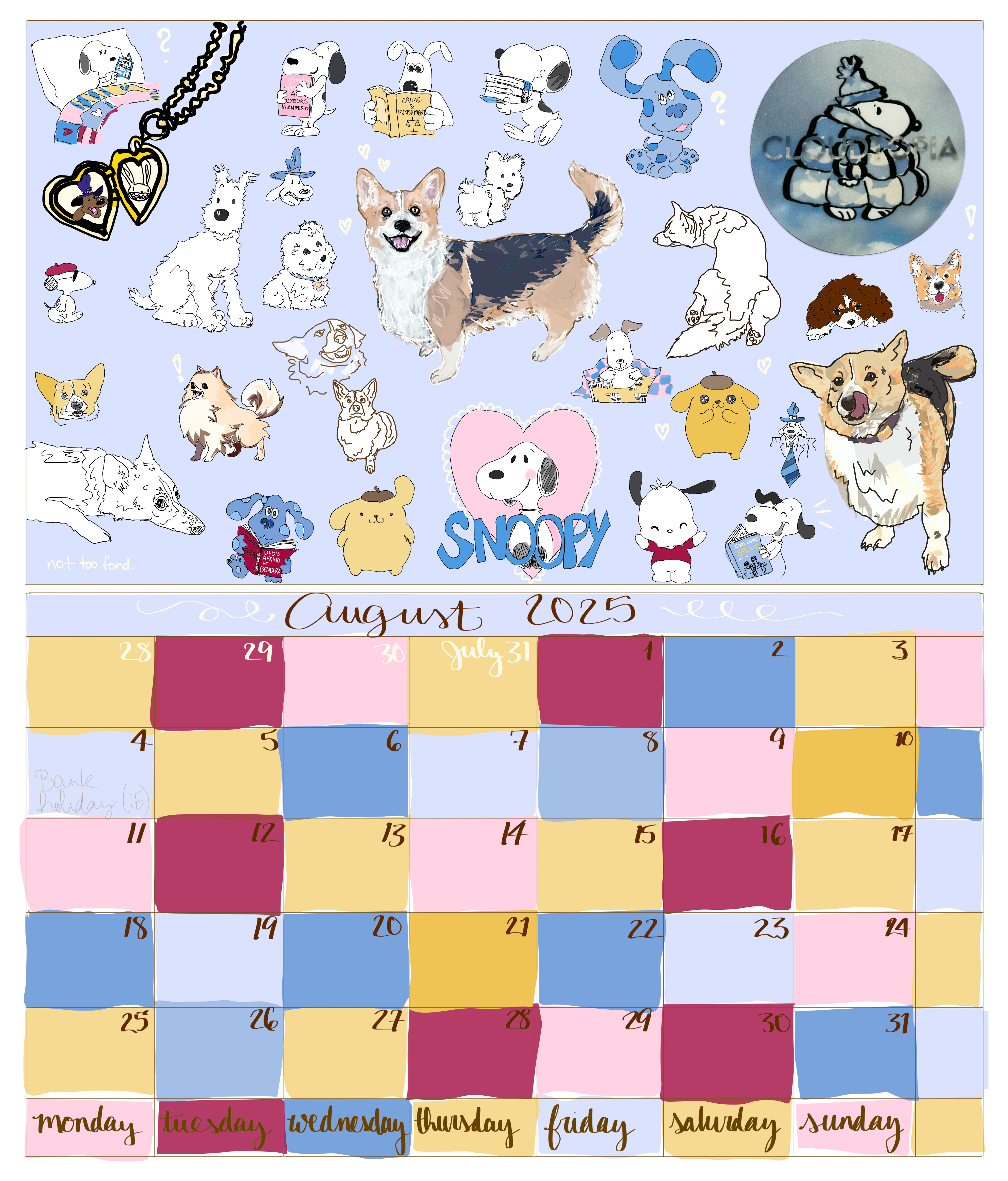
i’ll leave you for now with one more thing: an august calendar page !
trinketfully,
isobel
It may interest some readers to know that he lived in Colorado Springs for several years??
As a matcha enjoyer I have to object to matcha being lumped in with other tiktok trends - matcha is just a type of tea. It has been for hundreds of years. Yes, it has gotten more popular and well known in the west in the past few years because of social media. No, it’s not for everyone. That doesn’t mean it doesn’t have culinary, cultural, or other value, and I don’t think it fits into the mold of Labubus or stanley cups or the other things it is categorized with by critics.
I really liked Crystal Bell’s article for mashable on the Labubu craze and the community that has developed around it — her conversations with collectors helped me see a more positive side of the whole blind box and collection scene.