

midatlantic
june reflections

We’ve passed the mid point of summer. Flowers are bright and in full bloom everywhere, the usually ever-green fields of the Irish countryside painted over with reds and yellows. Here in Dublin, it’s light pretty much all the time, the sun waking me up hours before my alarm and stretching the afternoon far into the night. This is the time of year when nature stops making sense.
In this month’s newsletter, we’ll be catching up on a wild atlantic adventure, thinking once again about the literary and cinematic canon of stories about long days in june, and, of course, I’ll be sharing my monthly favourite fragrances, beverages, albums, etc.!
i. across the water
(I present this section along with two songs that provided the inspiration for the title: uncle albert/admiral halsey and haunted water)
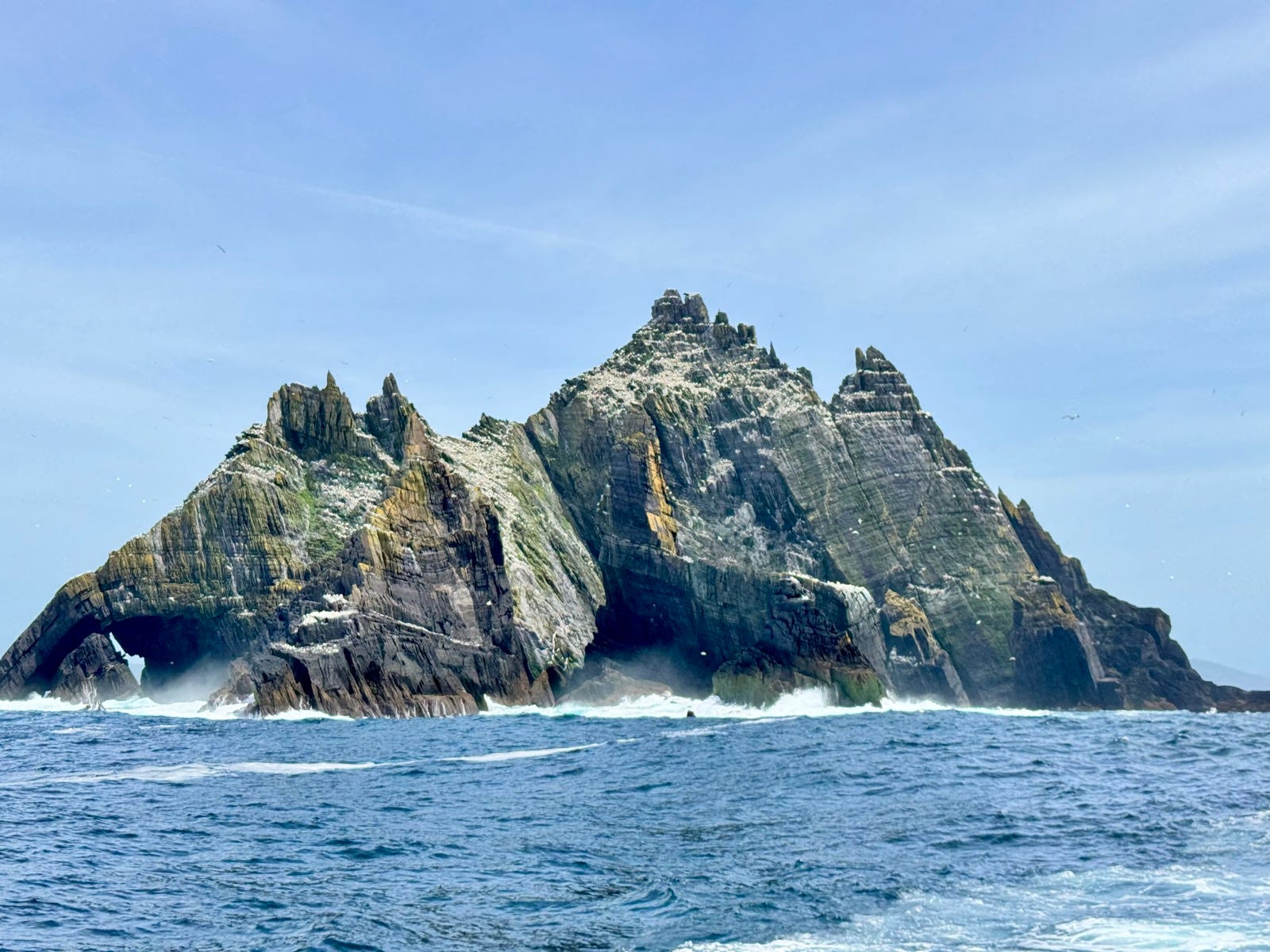
one of my dearest friends visited ireland earlier this month and at the end of a wonderful week of hang outs and catching up, we spent the weekend in County Kerry on a mission to see Skellig Michael. The Skelligs are small, rocky islands off the coast of south western Ireland. Situated on the Atlantic ocean, the weather is notoriously intense and unpredictable: strong winds, bursts of torrential rain, and waves rising several metres high are all very typical. The islands are also home to incredible sea bird populations, especially during the summer months when Atlantic Puffins and other birds gather to nest in the safe havens of the islands surrounding Ireland and Britain.
The Great Skellig, Skellig Michael, is a world heritage site, renowned for its puffin and sea bird colonies and its unique monastic settlement,1 which was built sometime around the 7th century and consists of several ‘beehive’ huts, small, simple dwellings made of rock. The monastery is rugged, remote, and designed for a small group of monks to live an extreme ascetic lifestyle, disconnected from much of the human world and surrounded by nature’s power and the harsh extremes of the Atlantic. The monks lived amidst the rocks and the birds and the water, at the very edge of the known world.
Centuries later, a visit to Skellig Michael is still very much like a spiritual pilgrimage. Infamous as its extreme weather conditions are, travel to and around the island is only possible during a few months out of the year, and even then only a fraction of scheduled boats actually make it out to the island, much less to land on its rocky shore. We went into the trip knowing we were at the mercy of Atlantic currents, and despite the unusually sunny and clear day that we awoke to on the ring of Kerry that morning, extreme sea currents and big waves meant that landing on the island would be impossible, as there are no docks and visitors must step directly onto a precarious stone staircase from the boat. Nevertheless, the boat could still ferry us on a tour around the Skelligs and nearby islands, so we set out to sea.
The trip was unbelievably beautiful, tracing alongside the green fields and rugged cliff faces of coastal islands, past colonies of sea birds - razorbills, gannets, gulls, guillemots, shags, murres, and, of course, atlantic puffins. The young puffins were just learning how to fly at this point of the summer, and we saw big groups of them floating together on the water, then attempting flight, aggressively flapping their little wings but barely making it above the surface of the ocean, skipping like little stones just along the tops of waves. The Skelligs were beautiful and deeply impressive, the high spires of Skellig Michael, up above the beehive houses where the monks once dwelt, towering over us as our boat approached its rocky shores.
It did not come as a surprise to me that I felt seasick on the boat. I get motion sick easily—on car rides along windy roads(or if I spend any amount of time looking at my phone), on crowded city buses and trams, last summer on the ferry across the irish sea when bad weather made me feel so ill I spent the entire journey sitting as still as possible, silent and unable to move, etc. But I still, somehow, felt unprepared for the intensity of being in a tiny boat on the Atlantic ocean, high jumping waves making us all feel absolutely terrible. I took motion sickness tablets before the trip and I wore my motion sickness wrist band and I kept my gaze fixed on the skyline and tried to think about anything other than how sick I felt and the rising panic of being so far from land and not wanting to throw up.
To distract my mind, I found myself thinking again about the monastery out there on the great island and the lives of the monks and pilgrims who would have made this same journey hundreds of years before. I tried to reach for spiritual tools of mantra and prayer, moving my fingers over the chain links of my necklace like a rosary. Instead of fighting the feeling of the sea and the panic of seasickness, I let the rhythm of the waves guide the cycle of my thoughts. I was adrift, rising and falling on crashing waves, but the more I was able to embrace it, to feel myself melting into the oneness of endless blue sky and the ever changing, impermanent water, I felt calmer. It didn’t cure my seasickness, but I knew that I could endure the journey.
Returning to land felt miraculous, and we sat on the ground near the dock for a while, all of us recovering from the journey and looking out at the water and that distant island we had gone out to see, already receding into the mists like it had not all been real. I felt like I had undergone a spiritual trial and survived.
That afternoon, we went up to the Kerry cliffs and got to look down again on the ocean and the surrounding islands from high above, and felt awed again by the incomprehensible depth of that blue water and the Skellig, its rocky peaks and distant shore only just visible on the horizon, like looking out to the edge of the world.


ii. superbloom
note: some of this section was originally published in a june 2024 newsletter.
in bloom

In one day of mankind are all the days of time/
The story of the world is told from dawn to darkness
The 16th of June in Dublin is a local holiday called Bloomsday, so named after Leopold Bloom, the main character of James Joyce’s almost absurdly controversial novel Ulysses. Set entirely in Dublin and covering over seven hundred pages, the story takes place all within the span of a day—16th June, 1904.
The date itself was chosen by the author because of its significance to him and his wife, and now over a century later, people around the city celebrate the anniversary with literary readings, special tours, live music, meals, and plenty more inspired by the events of the 16th as they occur in the book. Mostly, it’s an excuse for tourists and Dubliners alike to wear big hats and Edwardian-ish outfits, go to pubs, and pretend that they’ve read Joyce. I find it all very strange and immensely charming.
This is a book that was controversial when it was being written, when it was published, and has remained controversial basically every day since. It regularly gets singled out as one of the best novels ever written, as well as one of the most hated. Say what you will about Ulysses — which, I feel like I should say I have in fact read and took a college course on and loved, but also understand why people tend to bristle at — but there’s something really magical about the enduring legacy of this text. Over a hundred years later, it still has psychic and tangible effects on the landscape of the city its author once called home.

The novel was written, in part, as a reflection of the city itself. Joyce famously wrote that “I want to give a picture of Dublin so complete that if the city one day suddenly disappeared from the earth it could be reconstructed out of my book.” Today, Dublin city is also a reflection of the novel, its places and people and imagined events etched into the cobblestones and recorded on plaques as if they were real and historical. Ulysses has become the fabled map of a city that is so detailed that it is as big as the city itself, nearly eclipsing it. Dublin’s map is Joyce’s; past and present, fact and fiction all blend into one every Bloomsday.
The text, in addition to exploring broad areas of the city of Dublin with incredible detail, follows a massive array of themes and ideas, covers a multitude of literary styles, engages deeply with emotion and experience and humanity—yet ultimately, it is the story about 16th June, one day in a life. That little contradiction, the combination of immenseness and specificity, generates something wonderful and timeless in the text, as well as in the communities and inspired works that have arisen from it.
A key text and source of inspiration for Ulysses is The Odyssey—Joyce took the Latin version of the hero Odysseus’ name as the title of his novel—and much of the character archetypes, story and chapter structures, and other elements are taken from the Homeric epic.
In Nostalgia: When Are We Ever at Home?, philosopher Barbara Cassin writes about the Odyssey and the imaginary of temporal experience in the text.2 Odysseus’ journey home from war takes him ten years, a decade where time passes unevenly, with months or years spent on new shores before the journey is utterly changed in mere moments. All the while, he works towards returning home to his own country, to his wife Penelope who spends years faithfully waiting, and his son Telemachus who almost traitorously has grown from a child into a man in his father’s absence. When he returns at last he ends his adventure in his own bed, which he carved himself into a tree rooted in the soil of the island of Ithaca, a profound symbol of his homecoming.
As Cassin notes, however, Odysseus’ reward for surviving the seas and reclaiming his place in his rooted home is not the return he yearns for; instead he is fated to be sent off on another quest, one he will never again return home from. He is given one night to return to his root and to reunite with his wife, his home, and even himself, his lost identity and personhood that he can only reclaim when he has returned to his place. Yet even after a decade of waiting and wandering, the night of nostos—return, the root found in words like nostalgia—is an incredible expanse, and endless and perfect stretch of time before the sun rises and he must voyage onward.
The threshold of this moment in the story, Cassin argues, is essential:
“The infinite is here in the finite, a perfect description of love.”3
In the 1995 film Before Sunrise, Jesse(Ethan Hawke) and Céline(Julie Delpy) meet as strangers on a train. In the morning, Jesse will fly home to America, and Céline will continue to her intended destination of Paris, but until then the two spend a spontaneous day together in Vienna, getting to know one another more deeply as the night goes on. It is 16th June, 1994.
The bond the characters develop in the short span of time during which they are together has made this film a beloved, timeless romance for many viewers, and it is exactly the sense of infinite time and possibility that the two are able to find in their brief time that makes the story so magical. At the end of the story, the two part ways, with the promise to meet again. The sun must come up, they have to continue on. We don’t know whether they’ll find one another again, if they’ll have a future, or whether this is it3, but there is an endless, beautiful love shared in this moment, no matter what might come.
The final chapter of Ulysses, “Penelope” is written as an internal monologue, essentially a long run on sentence, as Molly Bloom lays in bed in the early hours of the morning thinking, and recalling her past relationships and experiences. In a schema he created as a map to the puzzles and ideas in the text, Joyce did not assign this chapter a specific hour of the day the way he did others, instead writing a symbol: ∞
There is an infinity of time in the wee hours of the morning. Infinite possibility, with the end result of the chapter and the novel in total being perhaps its most famous moment: a final affirmative declaration of “Yes.”
One of my favourite films, the brilliant Agnès Varda’s 1962 drama Cléo de 5 à 7(Cléo from 5 to 7), is another story to take place on a long day in June, playing out in (nearly) real time between five o’clock and seven in the evening. Awaiting biopsy results from the hospital, she is trapped in a sense of infinite anticipation and spiralling, superstitious anxiety. By chance, she meets a young soldier on the eve of his departure from Paris. Both awaiting uncertain fates, the time they spend together provides a sense of peace in the impermanent, finite present moment before she gets her results and he must catch a train. the two meet in a common place of uncertainty and finitude.
Time moves in incredible ways in this movie, almost stream of consciousness. Occurring mostly in real time, with on screen chapter headings reminding viewers of the precise passage of the minutes, the film progresses often without a clear trajectory or narrative as Cléo stares out the window of a taxi or watches street performances on crowded Parisian boulevards. It could so easily be a dull film to watch, and yet it is mesmerising to watch the minutes pass and to live out the evening of waiting with the protagonist, experiencing her moments of boredom, of delight, of worry and despair alongside her.
(I wrote about this film last year june, more on the film can be found in that newsletter)
cloudtopia from 5 to 7

“I'm afraid of everything” she admits, “birds, storms, lifts, needles, and now, this great fear of death.”
Jeffrey Eugenides’ debut novel, The Virgin Suicides, sees the lives and deaths of five teenaged sisters in suburban Michigan. It is an expansive story, narrated by the chorusing voices of a group of boys who try to make sense of the events from their idealistic, distant viewpoint of the girls. The story both begins and ends on the 16th of June.
In an interview with the Paris Review, Eugenides describes reading A Portrait of the Artist as a Young Man, Joyce’s predecessor to Ulysses, as a student, and the profound impact the work had on him and his interest in becoming a writer.4 It can be no coincidence that the date Joyce selected for his rambling epic is also the date Eugenides picks for his tragic teens’ suicides. The novel, dreamlike, takes place in an almost mythic time, its haunting narrative seeming to stretch endlessly across the short year that it primarily describes, throughout which the Lisbon girls are simultaneously alive, through the events of the story and in the way they are remembered by the narrators, yet knowing as we do that they are doomed, they are always already dead.
Just a few years after Joyce published his Dublin epic, noted Ulysses hater Virginia Woolf5 wrote Mrs. Dalloway, a novel which follows the events of a June day in London. Not unlike other works we’ve discussed here so far, much of the text is a stream of consciousness, and it has a beautifully flowing, contemplative style, perfectly suited to a long summer day and wandering thoughts. The titular character is preparing for a party, and as she busies herself with preparations and meets up with old friends, she also reflects on life and death and everything in between, a perfect encapsulation of memory and human experience in the mundane hours of a day. Its interwoven stories stretch across lifetimes as the characters think about past and present, their moment to moment experience layered with fleeting thoughts and childhood memories and reflections on life and being. All of time is stretched across the course of the single day of the novel, the infinite and the finite coming together, here, once again.


june favourites
fragrance: oyster!
Notes: “grey musk, ocean brine, bitter cucumber, a twist of lemon, elemi resin, and angelica”
this is a super unique and fascinating fragrance from Poesie, an indie perfumery. It is bright, salty, and aquatic, a scent that calls to mind beach days and cold atlantic water and sitting by the seafront without, miraculously, being off putting. Refreshing and evocative, Oyster! is a cool fragrance from a perfumery that seems to have a strong knack for storytelling in their fragrance catalogue, which is filled with literary references and interesting combinations I haven’t seen anywhere else.
“I will not be sworn but love may transform me to an oyster, but I’ll take my oath on it, till he have made an oyster of me, he shall never make me such a fool.” - William Shakespeare, Much Ado About Nothing6
beverage: mont blanc coffee from luna, killarney, county kerry
a decadent iced coffee to drink outside on a sunny day; this drink is complicated enough that I very rarely see it on menus but can never resist ordering it when I do. Cold brew is topped with a floating layer of heavy cream, over which freshly grated nutmeg and orange zest fall like snow. Visually, the drink is meant to evoke a snowcapped alpine peak. The addition of spice and citrus to the coffee make it really complex and bright, complementing the strong flavour of the cold brew and the richness of the cream as the layers mix together.
new album of the month: Neon Summer Skin - Bedouine
Extremely chill indie folk to listen to on hot summer afternoons, or late at night when the air is finally starting to cool and neon lights are coming on.
The opening song, “on my own” is an unexpected, melancholy, and beautiful ode to solitude.
My favourite track is “long way to fall”, a dramatic string opening giving way to a soft piano melody and Bedouine’s resonant alto vocals, blending perfectly into a 70s-y soft rock sound as the song goes on. “Look at me,” she sings towards the end of the song, “I’m on my way now”.
old album of the month: Ram - Paul & Linda McCartney
“admiral halsey/uncle albert”: Referenced once already up above, this is easily my favourite on the record. I remember hearing this song as a child and thinking “wait are they allowed to do this???” as I listened to the song’s digressions and jokes and shifts in key and tempo, unlike anything I’d ever heard before. An all time great song.
“heart of the country”: good for when you’re in the heart of the country!
“monkberry moon delight”: good song to listen to if u want to get scared.
film:
I saw two films in the cinema this month, both part of a summer series of classic movies screened on friday afternoons. The first was Holiday(1938), starring Katharine Hepburn and Cary Grant, a movie about a wealth, leisure, and doing backflips. The second was Pat and Mike(1958), which sees Hepburn as a female athlete(she's good at all sports.) paired with Spencer Tracy as a tough manager with weird mob ties and a love for only a horse(there’s kind of a lot going on here.). Readers may be interested to know that the opening sequence of this was filmed at Occidental College in Los Angeles, and while I can’t say it’s a great movie I had a very fun time seeing it. Great day to be a tiger :)
thank you as always for reading! if you enjoy cloudtopia, I would love it if you would subscribe, share with a friend, or tell me your thoughts, it always means the world.
I hope July brings more bright days and currents of change your way. i’ll catch up with you in a few weeks!
impermanently,
-isobel
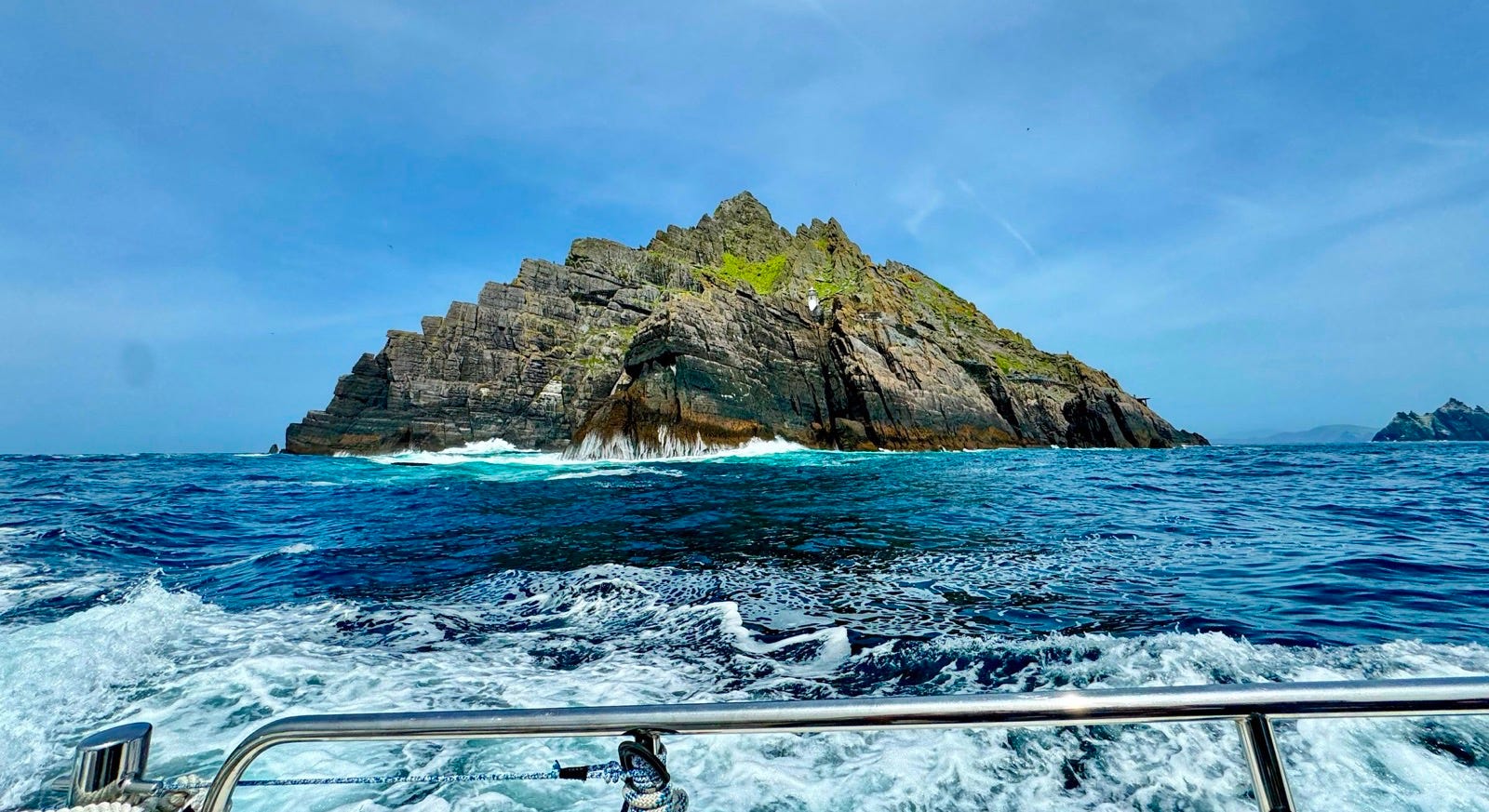
and, I have to add, for being a filming location for the third Star Wars trilogy ! look at this cool source for images + info: starwars.com
Cassin, Barbara, and Pascale-Anne Brault. Nostalgia: When Are We Ever at Home? Fordham University Press, 2016. https://doi.org/10.2307/j.ctt19rm9jg.
Cassin, 21.
James Gibbons (Winter 2011). “Jeffrey Eugenides, The Art of Fiction No. 215”. Paris Review. Winter 2011 (199).
Per Woolf, “Never did I read such tosh”. quoted by James Heffernan, “Woolf’s Reading of Joyce’s Ulysses, 1922-1941”
quoted in the copy for Oyster! on the poesie website