

pistachios & propaganda
on dubai chocolate and other rot

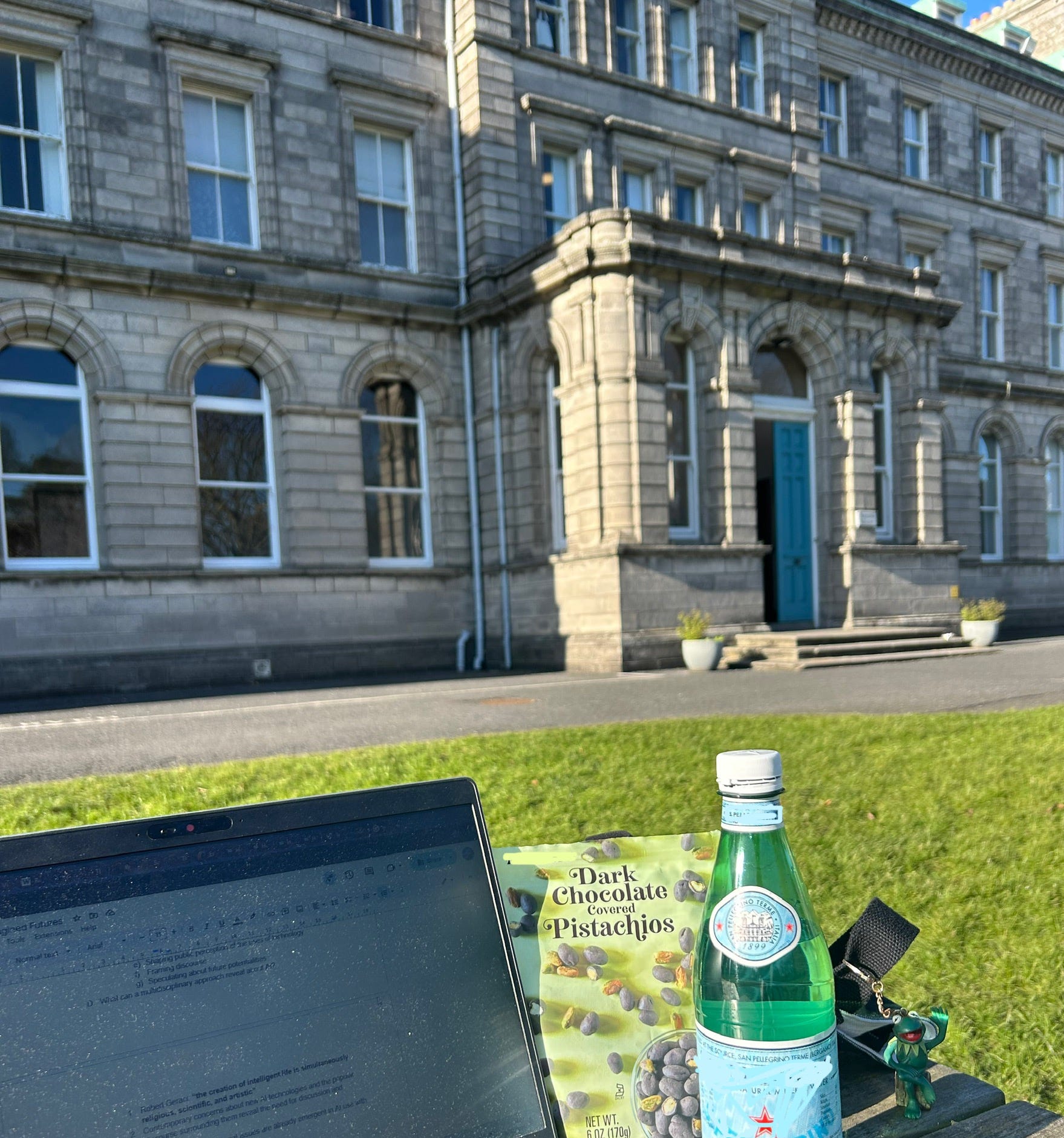
so. this week a colleague told me that when she orders a sandwich she asks chatgpt what toppings she should put on it.
she uses chatgpt everyday and asks it “everything”.
I wanted to say “don’t you know what you like to eat?” but held myself back. the group conversation was already moving on. I still have the same question, though: don’t you know what you want? and shouldn’t it be something better than this?
Someone else I know at work has apparently been using ChatGPT as a therapist. Another person tells me that he loves AI and views it as a friend. It’s one thing to read about these phenomena in think pieces online, but another to see them in person, with people that I previously thought were more or less sensible.
So, okay, maybe I’m just being judgmental, or falling behind the times. But I don’t think so. I’ve been writing throughout the year about AI and my doubts about its utility and social impact, as well as my my worry about the realities of technology which fail to match up to the big promises of tech corporations and science fiction imaginings. I am not alone in talking about these things, and I will continue to do so. At meetings about the use of AI in my workplace this week, I was relieved to find that I was not alone in my concerns and the most vocal in the room were those of us who doubt the feasibility of technology in our work areas, who do not trust the hype of big tech or how they are using our data, who worry about the ecological costs, who are concerned about the future of critical thinking and learning to overcome difficulties when AI is relied upon. Despite the narrative that AI is the unavoidable future, plenty of people are still trying to push for something better.
This newsletter isn’t actually about AI, or at least it wasn’t meant to be, but it is about another topic of idle workplace discussion and internet slop. I cannot ignore it any longer - I want to talk about dubai chocolate.
I’ve never actually tried one the famous dubai chocolate bars, and honestly I’m a little scared to because I think I might actually like it. The original chocolate bar was brought onto the market by Sarah Hamouda and Nouel Catis Omamalin. Hamouda sought to create a food that combined an array of flavours: chocolate, pistachio, the syrupy, crunchy kadayif pastry of knafeh, and tahini. The result was a bar sold in Dubai by the chocolatiers under the somewhat silly title “Can’t Get Knafeh”. It then became a viral sensation on tiktok and elsewhere online, where influencers posted footage of the chocolate bars which popularly became referred to as ‘dubai chocolate’.
From there, dubai chocolate became a true phenomenon. Chocolate companies around the globe began producing replicas, and it spread further as pistachio and chocolate were suddenly adopted and labeled ‘dubai’ everywhere.
Most of the products I see in regular life that are given this label are missing some of the ingredients of the original confection, and mostly they are just chocolate and pistachio paste, which has already been a thing forever? The pistachio baklava at the greek bakery in my neighbourhood suddenly has a drizzle of chocolate and a dubai chocolate label and costs more. Snacks I’ve eaten in the past are being renamed and I don’t want them anymore.
Kyle Chayka wrote about the proliferation of dubai chocolate as an example of what he calls ‘irl brain rot’, alongside labubus and the matcha-in-everything craze:
“people have taken to stringing together these signifiers into one manic phrase, Labubumatchadubaichocolate, as a way to refer to a broader Zeitgeist and its elaborately artificial aesthetic. It may appear nonsensical, but its nonsense has a purpose.”1
As this aesthetic of irl brain rot spreads, this nonsensical blend of internet trends, marketing, and our social media obsession with spending and consuming is made manifest in a material culture that exists primarily to uphold the digital ideal.
And further, that material culture is becoming flattened, homogenised. Specialty products like dubai chocolate once made only in certain places by specific artists can now be found everywhere. You can order a matcha from a sterile, indistinguishably instagrammable café in just about any city in the world. Even labubus, with their allure of scarcity, are sold broadly, ready to be posted online from every corner of the globe.
snoopyversary

In which I investigate the origins of Labubu and some other characters that enjoy wild popularity online.
Matcha lattes purchased just to be posted online, matcha in skincare products added just to promote a product, dubai chocolate on every shelf in order to feed the ever hungry algorithmic beast. Instead of the internet reflecting real world interests and culture, reality instead is reshaped to reflect the trends of digital culture; hyperreal.2
Here’s the next question: what is ‘dubai’ about this chocolate?
There’s the obvious part: the original chocolate bar was produced by a Dubai based chocolatier. But the vast majority of what is produced with the name dubai chocolate is not made there at all. Instead, it has morphed from a descriptor of one specific, real world creation to a digital construct, spilling out from social media into the world again.
Dubai and influencers tend to go hand in hand, and this trend was no exception. As Monique Naval suggests, "Having Dubai in the name also adds to the chocolate's popularity and hype…feelings of indulgence drive the success of Dubai chocolate,"3 It is a signifier then not just of internet culture and being on trend, but also of a lifestyle, of new money and influencer status and the overly polished, filtered glitz of a tiktok or an instagram reel about ‘a day in my life in Dubai’.
Much like the chocolate named for it, the city of Dubai is a confection constructed of somewhat disparate parts. Once the site of a pearling and fishing village, Dubai has a long history, but the city as it exists today is relatively very new. It is a place of incredible inequality, where the ultra wealthy live off the invisible work of mistreated migrant labourers who built the city.4 The world of skyscrapers and new money glamour that we associate with Dubai today is an artificial construct, enforced by strict laws5 and reiterated in the sand of artificial beaches and islands were tourists take instagram photos, and 3D printed office buildings where international deals are made.6
Dubai has been very successful at marketing itself, promoting its self image of opulence and its tourism industry. And in recent years, as Adele Walton writes, “Dubai has established itself as the poster child of luxury holidays, and influencer marketing is its golden ticket to industry dominance.”7 Paid influencer trips and sponsored content provide a valuable way to promote a certain image of Dubai, and the marketing of dubai chocolate is just another way in which this happens. But, as Walton argues, these narratives might also serve to cover up the darker realities of life for Dubai’s hidden underclass, and the many human rights issues and violations that are buried underneath glittering high rises. And like dubai chocolate, the city itself is caught in a hyperreal loop, its image no longer necessary to promote the real world of the city, instead the city is constructed artificially to uphold the image we see on a screen; to prove that the glamour of it all is what is truly real.
i don’t think I’ve ever written the word chocolate this many times before in my life so i’ll leave you now with the song that has been stuck in my head through all the final stages of publishing this one(you can go to like 1:20 lol):
-isobel
Kyle Chayka, “IRL Brain Rot and the Lure of the Labubu” The New Yorker, Aug 2025
rip Jean Baudrillard you would have loved labubu matcha dubai chocolate
Monique Naval, quoted by Soumya Gayatri in “How Dubai Chocolate Conquered the World” BBC, 4 May 2025
One of many concerning stories is this case from last year: “UAE police withdraw woman’s attempted suicide charge”
the article also mentions the human rights legal group Detained in Dubai, which provides assistance to those who come into conflict with the law and works to raise awareness about the human rights injustices in Dubai.
Muaz Emre, “Apis Cor Completes The Dubai Municipality, Largest 3D-Printed Construction” Parametric Architecture, 12 July 2022.
Adele Walton, “The Dark Truth About Dubai’s Influencer Marketing” Tribune Magazine, 4 December 2020.